
Table of Contents
ToggleIntroduction
A short monster romance has to move quickly, but it should never feel thin. Readers may expect a fast emotional pull, a vivid creature hero, a brave heroine, and a satisfying romantic ending, but they still want the story to feel complete.
That is the challenge. You do not have room for endless world-building, five side plots, a long family history, and three separate magical systems. What you do have room for is a clear emotional arc, a strong first meeting, a focused conflict, and a creature hero who becomes more understandable with every scene.
Start With One Strong Romance Promise
A short monster romance needs a clean promise. The reader should know what kind of emotional journey they are getting very early.
That promise might be “the feared guardian is secretly gentle,” “the heroine must trust the monster to survive,” “the monster everyone avoids is the only one who truly sees her,” or “a strange creature from a hidden world offers protection, but trust must be earned.”
Choose One Main Trope
Short romance works best when the story is built around one main trope. You can add flavor, of course, but the spine should stay clear.
Maybe it is forced proximity in a haunted forest. Maybe it is protector romance with a cursed creature hero. Maybe it is a first-meeting rescue that turns into a hidden-world romance. Maybe it is a lonely guardian and the human heroine who refuses to believe the rumors.
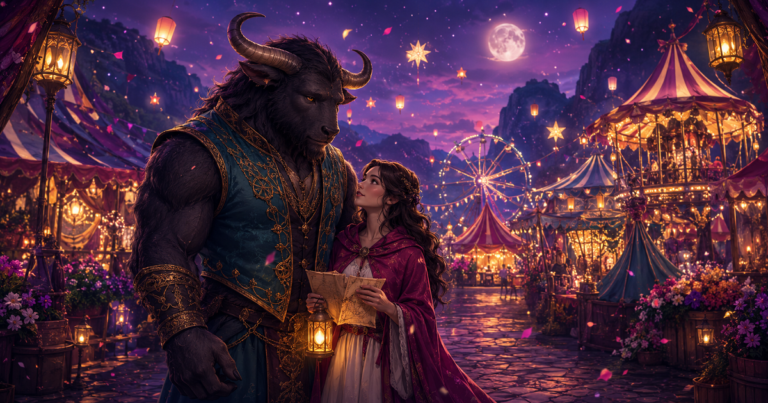
The chosen trope gives the reader a familiar shape. That is helpful when the monster element is unusual. If the reader understands the emotional setup, they will more easily accept the horns, wings, stone skin, antlers, glowing eyes, or strange customs that make the story feel special.
Keep the External Plot Simple
In a short monster romance, the external plot should support the relationship, not swallow it. The story does not need a sprawling war, three kingdoms, and a lost royal bloodline unless those elements are handled very lightly.
A simple external problem is often stronger.
The heroine is trapped in a snowbound valley. The monster hero guards the only safe road. A curse will close the hidden gate at dawn. Hunters are searching the forest. The old lighthouse only appears during a storm. The monster’s territory is dangerous, but leaving it too soon may be worse.
Those setups give you pressure without making the story crowded. The reader can stay focused on the couple, which is exactly where the emotional weight belongs.
Build the Plot Around Clear Story Beats
A short monster romance needs efficient story beats. Each scene should move the relationship, the external problem, or preferably both.
You do not need to make the structure stiff. Think of it as a path through the forest. The reader can still feel surprised, but they should not feel lost.
Use a Strong Opening Beat
The opening should place the heroine near the monster’s world quickly. Do not spend too long in ordinary life unless the ordinary life is essential to what she must leave behind.
A strong opening might show her entering a forbidden place, hearing a frightening rumor, fleeing a danger, finding the monster wounded, or discovering proof that the stories about him are not entirely true.
The first scene should create a question.
Who is he really? Why does he protect this place? Why is he feared? Why did he save her? Why does the hidden world seem to know her? That question pulls the reader forward while also giving the romance a little mystery.
Let the First Meeting Change Something
The first meeting should not be a decorative encounter. Something should shift before the scene ends.
Maybe he saves her, and now she owes him a debt. Maybe she sees him spare someone who expected no mercy. Maybe he lets her leave, even though keeping her would be easier. Maybe she realizes the feared monster is guarding the village from something worse.
That shift gives the story movement.
In a short romance, every major beat should leave the couple in a different emotional position. At first she fears him. Then she questions the fear. Then she sees his restraint. Then she trusts him with one small thing. Then she chooses him when it costs something.
Limit the Cast and the World-Building
Short monster romance does not have room for too many characters. Every side character should have a clear job.
The same applies to world-building. You do not need to explain the entire history of the monster’s people. You only need enough detail to make the romance feel vivid, believable, and emotionally grounded.
Use Only the Characters You Need
A short romance may only need the hero, heroine, one source of danger, and perhaps one supporting character who reveals something important. That is enough.
A suspicious villager can show how the world misjudges the monster. A child or injured traveler can reveal his hidden kindness. A hunter can create danger. An old woman can explain one piece of lore. A rival creature can show what the hero refuses to become.
Each character should serve the central relationship.
If a side character does not test the romance, reveal the hero, pressure the heroine, or move the plot, consider cutting them. Short books are not small because they lack depth. They are small because they choose their focus carefully.
Reveal Lore Through Romantic Pressure
World-building should arrive through moments that matter to the couple. This keeps the story from becoming a lecture.
Maybe the heroine learns that accepting the monster’s cloak means she is under his protection. Maybe she discovers that his people never share their true name unless trust has been earned. Maybe his glowing markings are not decoration, but a sign of pain, memory, or devotion.
These details do double duty.
They make the world feel strange, and they deepen the relationship. That is exactly what you want in a short monster romance. One detail should carry more than one kind of meaning.
Make the Emotional Arc Visible
A short monster romance can move quickly, but the emotional arc still needs to be clear. Readers will accept fast love more easily if they can see each step.
The heroine should not leap from fear to devotion without evidence. The monster hero should not go from guarded to open without a reason. Their connection can grow fast, but it should grow through visible moments.
Move From Fear to Curiosity
Fear is often the first honest reaction in monster romance. The hero may be enormous, shadowed, strange, or surrounded by terrible stories. The heroine’s fear should make sense.
But fear should not stay frozen.
Something about him should complicate it. He steps back when she is afraid. He speaks gently. He protects something small. He refuses to use his strength carelessly. He lets her see that the story everyone tells about him has missing pieces.
That is where curiosity begins.
Curiosity is the bridge between fear and trust. It gives the heroine a reason to keep looking, and it gives the reader a reason to keep turning pages.
Move From Curiosity to Trust
Trust should grow through repeated choices. Since the story is short, those choices need to be clean and memorable.
He tells her the truth when lying would protect him. She keeps his secret when sharing it would make her life easier. He gives her a way to leave. She comes back. He respects her boundary. She chooses to stand beside him.
These moments do not need to be huge, but they need to be specific.
By the time the romance reaches its emotional peak, the reader should understand why the heroine trusts him. Not because he is mysterious. Not because he is powerful. Because he has shown care, restraint, honesty, and devotion.
Use One Central Conflict
A short monster romance works best with one central conflict that tests the couple. The conflict should be simple enough to understand, but emotionally meaningful enough to matter.
The best conflict often asks one question: can these two trust each other enough to choose love despite fear, difference, or danger?
Make the Conflict Personal
The conflict should not only be about defeating a threat. It should press on the relationship.
If hunters arrive, does the heroine believe the monster or the rumors? If the hidden gate opens, does she leave or stay? If his curse worsens, does he push her away to protect her? If the village turns against him, does she remain silent or speak?
That is the real story.
External danger matters because it forces internal choices. The monster outside the door is less interesting than the choice inside the heroine’s heart. The curse is less interesting than what it reveals about the hero’s fear of being loved.
Let the Midpoint Reveal Change the Relationship
A short romance benefits from a strong midpoint reveal. This is where the heroine learns something that changes her understanding of the monster hero.
Maybe he has been protecting the village all along. Maybe the curse was not his fault. Maybe he is feared because he took blame to save someone else. Maybe the hidden world he guards is not dangerous, but fragile.
The reveal should not solve everything.
It should deepen the emotional problem. Now she understands him better, but choosing him may cost more. Now he has let her see the truth, but being known makes him more vulnerable. A good midpoint reveal opens the heart of the story rather than closing it.
Write a Satisfying Short-Book Climax
The climax of a short monster romance should bring the external conflict and emotional arc together. It should not feel like a random action scene pasted onto the end.
The final test should prove what the couple has learned. It should show trust, choice, devotion, and change.
Force a Clear Choice
At the climax, the heroine should have a clear choice. So should the monster hero.
She may choose to believe him when everyone else turns away. He may choose honesty instead of hiding. She may choose the hidden world. He may choose her freedom over his fear of losing her. She may stand beside him publicly. He may stop believing that love is impossible for someone like him.
Make the choice visible.
Short romances do not have time for vague emotional endings. The reader needs to see the moment when fear gives way to trust and trust becomes love.
Give the Ending Emotional Warmth
The ending should feel complete, even if the wider world still has mysteries. The couple needs an emotional landing place.
Maybe they remain in the monster’s hidden valley. Maybe they return to the village together, changed. Maybe she keeps his true name. Maybe he leaves a lantern burning for her, and this time she walks toward it without fear.
The final image matters.
In short romance, one beautiful closing gesture can do a lot. Bring back a detail from the first meeting: the hand that waited, the cloak offered, the doorway he would not cross, the name he would not speak, the path through the forest. Let it mean something different now.
That creates satisfaction. The story has come full circle, but the characters have changed.
Final Thoughts
Plotting a short monster romance is not about squeezing a full epic into fewer pages. It is about choosing the right emotional shape and following it with care.
Keep the cast focused. Keep the world-building useful. Give the couple a strong first meeting, a clear source of pressure, a midpoint reveal, and a climax built around choice. Let the creature hero remain strange, but make his heart readable through action.
Most of all, let the romance be the spine. The monster details give the story flavor, texture, and wonder, but the emotional arc gives it meaning.
A short monster romance can absolutely feel rich. It just has to know what it is about: two different beings moving from fear to curiosity, from curiosity to trust, and from trust to the brave decision to choose each other.